

A prime residential asset can look ordinary from the street while carrying a highly asymmetrical opportunity beneath the surface: a motivated seller, unresolved title complexity, deferred renovation, estate transition, lender pressure, or a transaction that cannot be exposed to the open market. Prime residential value add is the discipline of identifying that dislocation before it becomes visible, pricing the execution risk correctly, and controlling the path from acquisition to monetization.
For sophisticated capital, this is not a retail renovation strategy. It is a private real estate operating model where sourcing, legal architecture, underwriting, construction oversight, disposition, and reporting function as one integrated system. The return thesis is created as much by selectivity and speed of execution as by the property itself.
Contents
What Defines Prime Residential Value Add
Prime residential value add focuses on residential assets in supply-constrained, high-demand submarkets where liquidity, buyer depth, and long-term wealth concentration support a credible exit thesis. In Miami and select Florida markets, these assets may include luxury single-family residences, high-quality condominiums, and properties with material repositioning potential.
The distinction is essential. “Prime” does not simply mean expensive. It refers to an asset’s position within a market defined by enduring demand drivers, limited replacement supply, favorable location characteristics, and a buyer base with the capacity to transact. “Value add” does not mean cosmetic work for its own sake. It means a defined operational intervention that can improve marketability, functionality, compliance, design positioning, or sale velocity relative to the acquisition basis.
The best opportunities are frequently unavailable to the broad market. They arise through local relationships, direct-to-owner dialogue, estate representatives, legal channels, distressed situations, and specialized intermediaries. That access is valuable only when paired with the discretion to assess a transaction without reacting to market noise.
The Investment Thesis Begins Before Acquisition
In institutional real estate, an attractive purchase price is not an investment thesis. It is only one underwriting input. The real question is whether the manager can create a controlled spread between total basis and a conservatively supported exit value while preserving sufficient margin for time, construction, legal, and market risk.
A rigorous underwriting process begins with acquisition discipline. It tests comparable sales, neighborhood absorption, buyer preferences, renovation scope, permitting constraints, insurance exposure, carrying costs, tax implications, and multiple exit scenarios. It also requires an unflinching view of what should cause the firm to walk away.
That last point matters. Off-market does not automatically mean mispriced. A private transaction may carry hidden physical defects, unresolved liens, family disputes, zoning limitations, or unrealistic seller expectations. Institutional judgment is expressed in the transactions declined as much as in those acquired.
The underwriting should establish a clear capital stack, a detailed scope of work, a contingency reserve, a target hold period, and a defined disposition plan before capital is deployed. When the thesis depends on an aggressive resale assumption or an open-ended construction timeline, the opportunity is not yet sufficiently engineered.
Control Is the Source of the Edge
Prime residential value add is often described as a property strategy. In practice, it is a control strategy.
The manager must maintain visibility across the complete investment cycle: asset sourcing, diligence, legal closing, contractor selection, budget approval, draw management, construction milestones, staging, marketing, buyer negotiations, and final settlement. Fragmented responsibility can dilute accountability at every stage. A manager who delegates critical execution functions without a strong governance framework may lose the ability to protect both timing and basis.
At ARCSA Capital, the operating premise is that capital protection and operational traceability are inseparable. Every material decision should be documented, reconciled against underwriting, and reviewed through a disciplined approval structure. This is particularly relevant for international investors and institutional LPs, who require more than a market narrative. They require visibility into how capital is governed once it enters the vehicle.
Control also creates the ability to react early. If a permit is delayed, a contractor underperforms, a comparable sale changes market expectations, or a buyer segment softens, the correct response is not denial. It is a prompt reassessment of budget, timeline, and exit strategy. A short hold period can reduce exposure to broader market cycles, but it also leaves little room for operational complacency.

See ARCSA Capital’s Prime Residential Value Add Programme
Qualified investors can review sourcing data, completed-asset results and the governance framework behind our South Florida strategy.
Request InformationWhy Accelerated Exits Matter
A value-add project does not need to be held for years to create value. In certain residential transactions, the objective is to acquire, reposition, and exit in approximately five to six months, subject to the specific asset, scope, approvals, and market conditions. The focus is not merely speed. It is disciplined capital velocity.
When capital is returned efficiently and redeployed into new qualified opportunities, the portfolio may benefit from multiple investment cycles within a year. This is the logic behind compounding in an actively managed real estate strategy: capital is not left idle after a project has completed its purpose.
However, accelerated exits are not a substitute for prudence. A rapid disposition plan requires an asset type with demonstrated liquidity, renovation work that can be precisely managed, and an exit price grounded in current evidence rather than aspirational projections. The appropriate hold period depends on the asset and the market. Extending a hold can be rational when a short delay protects value; forcing a sale simply to meet a calendar can destroy it.
For this reason, a 21% annual target should be understood as an objective within a disciplined investment framework, not as a promise of performance. Actual outcomes depend on sourcing quality, execution, market conditions, transaction costs, financing terms, and risks that cannot be eliminated. Sophisticated investors do not confuse a target with certainty. They evaluate whether the process supporting that target is credible, repeatable, and appropriately governed.
Governance Is Part of the Asset
In private real estate, the property may be the visible asset, but the investment structure determines how risk, reporting, tax considerations, and decision rights are managed. For accredited investors, family offices, and institutional capital, this architecture is not administrative detail. It is a central component of the allocation decision.
A properly structured strategy requires clear fund documentation, investor eligibility procedures, anti-money laundering controls, tax reporting protocols, audited financial discipline, and a defined governance model. Cross-border capital introduces additional complexity. Investors from Latin America and other international jurisdictions may need a structure that considers U.S. tax exposure, reporting obligations, estate planning concerns, and the practical administration of capital flows.
A parallel fund structure in the Cayman Islands can provide an efficient framework for eligible international investors when designed and administered with appropriate legal and tax counsel. It is not a universal solution, nor should it be presented as one. The relevant question is whether the structure aligns with the investor’s domicile, objectives, tax profile, and institutional requirements.
Regulatory discipline also matters because it creates a culture of accountability. SEC-oriented compliance practices, IRS reporting awareness, independent audit standards, and documented controls reduce ambiguity around how a manager operates. They do not remove investment risk. They make the risk easier to identify, evaluate, and monitor.
The Questions Sophisticated Capital Should Ask
Before allocating to a prime residential value-add strategy, an investor should look beyond headline return targets. The more revealing questions concern process: How are off-market opportunities sourced? Who approves acquisition and renovation budgets? What assumptions drive the exit value? How are cost overruns handled? What occurs when an asset exceeds its planned hold period?
The answers should be specific. A manager should be able to explain its sourcing channels without compromising confidential relationships, demonstrate how it validates comparable evidence, and show how investor reporting connects capital deployed to operational milestones. Vague assurances are not a substitute for a documented investment process.
Investors should also assess alignment. Meaningful GP commitment, defined fee structures, transparent conflict management, and clear distribution mechanics all shape the quality of the partnership. In a selective private-market strategy, access is only valuable when the governance surrounding that access is equally strong.
The most compelling residential opportunities rarely announce themselves through broad marketing campaigns. They are found in the quiet interval between a seller’s need for certainty and the market’s ability to recognize value. For capital seeking disciplined exposure to Florida residential real estate, the decisive advantage is not simply finding that interval. It is having the institutional architecture to act on it with precision.
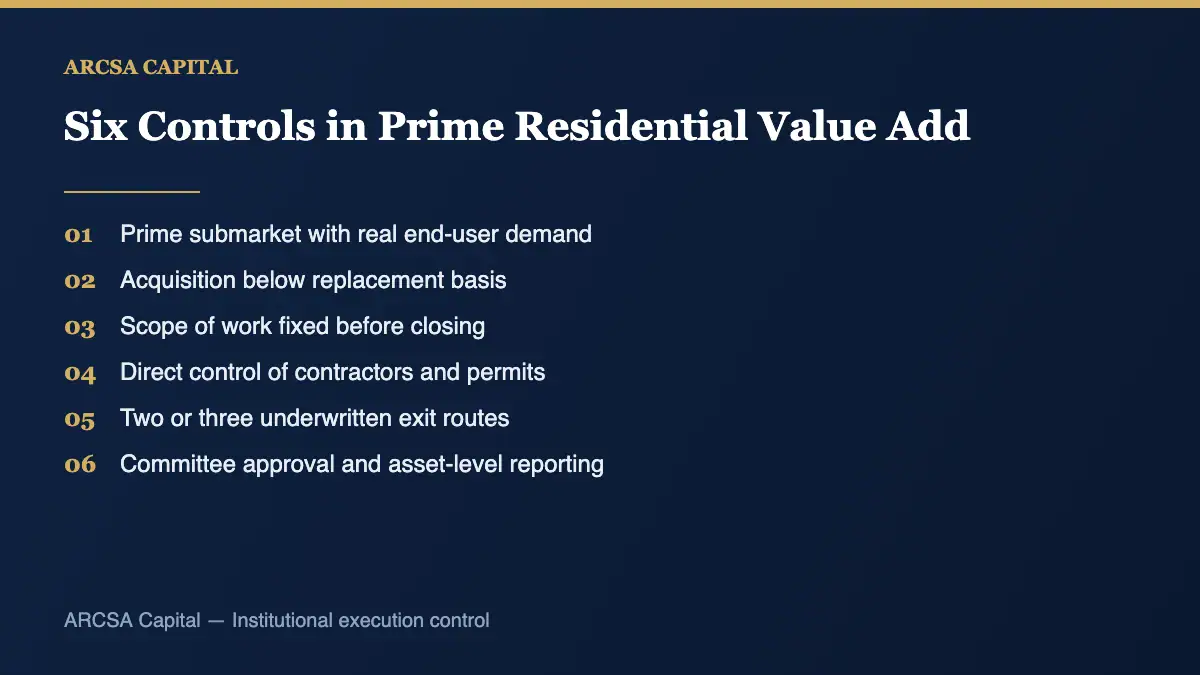
Prime Residential Value Add: 6 Points at a Glance
A prime residential value add programme is judged by what the manager controls, not by the quality of the neighbourhood. The six points below are what an institutional allocator should be able to verify before committing.
- Location quality that survives a downturn. Prime submarkets with genuine end-user demand, not speculative inventory.
- Acquisition below replacement basis. The entry discount is the first component of the return.
- Defined scope of work. Budgets, vendors and timelines fixed before closing, not negotiated during construction.
- Direct execution control. The manager controls contractors, permits and schedule rather than outsourcing the outcome.
- Underwritten exit. Two or three validated exit routes established before acquisition.
- Institutional governance. Committee approval, documented valuations and asset-level reporting.
Any local operator can achieve one or two of these. A prime residential value add strategy delivers all six repeatedly and can evidence each one with documents.
What Regulators and Public Filings Reveal About Prime Residential Value Add
In the United States, this strategy is executed almost exclusively through private fund vehicles offered to accredited and qualified investors. The regulatory regime requires disclosure rather than approval, so verification falls to the investor.
That makes the sponsor’s public record the natural starting point. Adviser registrations, exempt offering filings and disciplinary history describe the platform behind a prime residential value add programme long before any individual property is reviewed.
Filings and adviser records published by the U.S. Securities and Exchange Commission let an investor confirm the entity, its principals and its offering history before evaluating a single prime residential value add asset.
Common Mistakes Investors Make With Prime Residential Value Add
The strategy fails in a small number of recognisable ways, and each is visible before commitment.
- Confusing a prime location with a prime opportunity. Quality submarkets can still be bought at the wrong basis.
- Accepting renovation budgets built from national averages rather than the manager’s own historical variance.
- Underestimating permit timelines, which are the most common cause of extended holding periods.
- Assuming the exit buyer pool is stable because it was stable during fundraising.
- Treating a prime residential value add fund as a series of independent deals rather than one operating platform.
A manager running a genuine programme will answer all five with data drawn from completed assets rather than from projections.
How to Evaluate Prime Residential Value Add in 30 Days
Week One: Examine the Pipeline
Request the sourcing history and the last twenty completed assets. In prime residential value add, the pipeline is the product.
Week Two: Rebuild the Economics
Reconstruct three completed projects from acquisition to sale using the manager’s own inputs, and compare projected against realised.
Week Three: Review the Structure
Read approval thresholds, fee stack, leverage limits and reserve policy. Confirm that material decisions require committee approval.
Week Four: Interview the Operators
Speak with the construction lead and the compliance function directly. Close with a written memorandum on the prime residential value add thesis.

Frequently Asked Questions About Prime Residential Value Add
How does this differ from core residential investing?
Core strategies buy stabilised assets and collect income. A prime residential value add programme buys below replacement basis, executes a defined scope of work, and realises the gain through sale, which produces a shorter duration and a different risk profile.
What drives the return most?
Entry basis and velocity. Because prime residential value add generates little income during the hold, an extended timeline compresses annualised return faster than a modest reduction in exit price.
Why does control matter so much?
Because every element of the return depends on execution. A manager who does not control contractors, permits and schedule is exposed to third parties for the outcome the investor is paying for.
Key Takeaways on Prime Residential Value Add
- Prime location and prime opportunity are not the same thing; basis decides which one you bought.
- Execution control, not market timing, is the durable edge in this strategy.
- Exit routes must be underwritten before acquisition, never discovered afterwards.
- Governance and reporting turn a prime residential value add programme into something an institution can monitor.
Evaluated on these terms, prime residential value add becomes a question about operating capability rather than about property selection. The investor is not underwriting a neighbourhood; the investor is underwriting a platform that has already proven it can convert basis and control into realised results.
Where Prime Residential Value Add Fits in an Allocation
Most institutions treat this strategy as a return-seeking sleeve with a short duration profile, positioned between opportunistic real estate and private credit. Capital is committed, deployed, returned and recycled, which produces a cash-flow pattern quite different from a ten-year closed-end fund.
That short duration is the main portfolio argument for prime residential value add. Capital typically returns within twelve to twenty-four months, which reduces blind-pool exposure and gives the allocator frequent opportunities to reassess the manager relationship.
The counterweight is concentration. The strategy depends on one operating team executing one process in one or two submarkets, so manager risk is high relative to a diversified core fund. Experienced allocators size the position accordingly and diversify across sponsors rather than within a single sponsor.
Market Conditions That Support the Strategy
Prime residential value add performs best when a persistent spread exists between off-market acquisition pricing and retail resale pricing, and when absorption in the resale market remains stable. Both conditions must hold at once; a wide spread with slow absorption produces inventory rather than profit.
Rising rates compress the strategy from two directions simultaneously, raising financing cost while reducing buyer affordability. Disciplined managers respond by lowering leverage, tightening scope of work and widening the entry discount required, rather than by increasing transaction volume.
Supply-constrained metropolitan markets with sustained in-migration remain the most dependable environment, because absorption stays predictable even when pricing moderates. That is why prime residential value add concentrates in a small number of markets instead of being applied nationally.
For an allocator, the practical implication is that market selection and manager selection are the same decision. A capable operator in a weak absorption market will still struggle, and a weak operator in a strong market will still leak return through cost and timeline overruns.
Request the Prime Residential Value Add Track Record
Realised holding periods, budget variance and net results for your investment committee.
Request InformationOr model your own scenario in the investment simulator
Or receive the ARCSA Capital investment thesis by email, with the entry, stabilisation and exit assumptions behind the strategy:
